d a n c e
〰️
d a n c e 〰️
Sobre o Fim
2026
Light design and operation
-
What lies beyond the end?
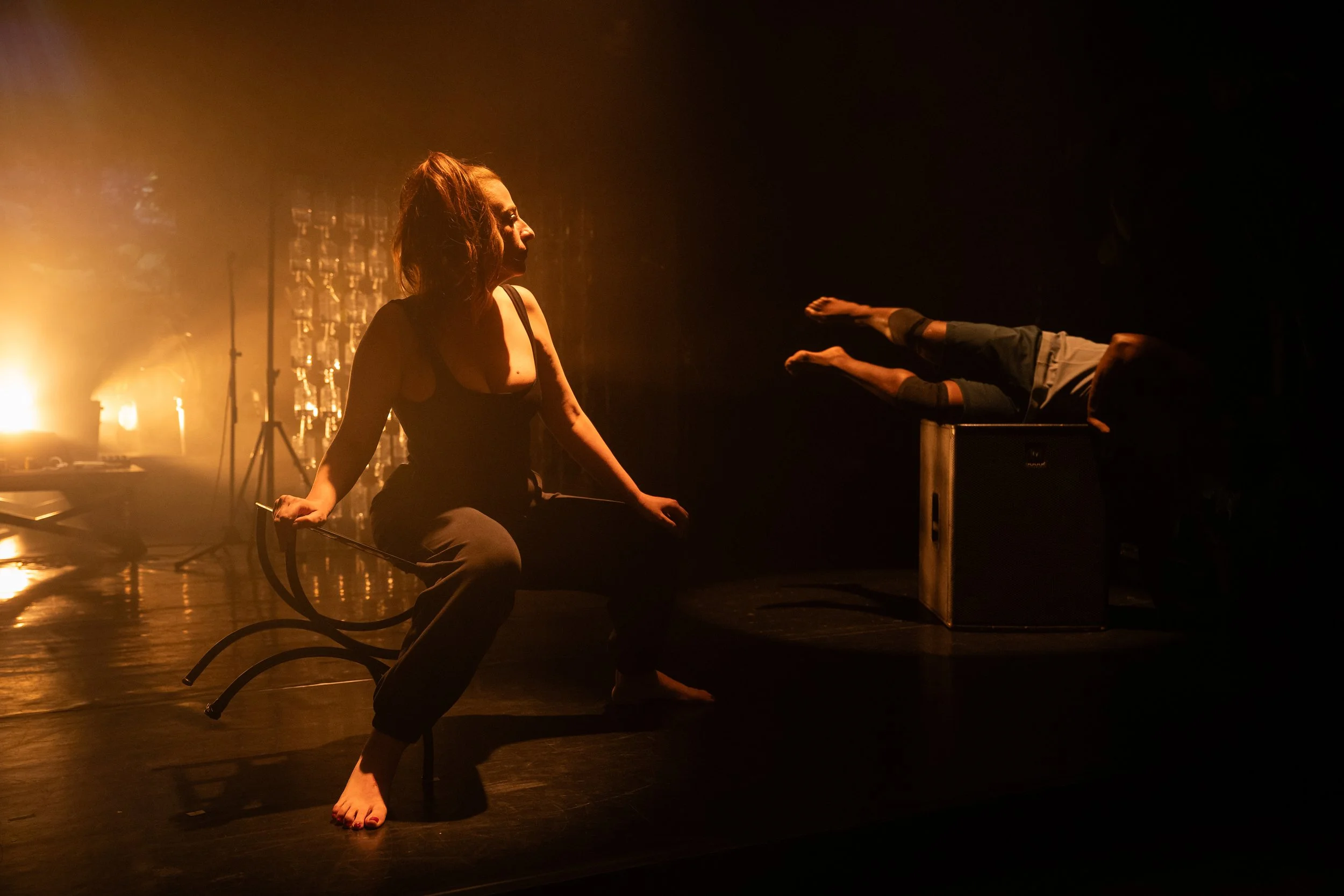
Sobre o Fim begins with the end of a romantic relationship, which becomes a reflection on the idea of endings, both individual and collective. The project investigates areas of intersection between humans and plants, a kind of botanical memory, creating a joint hallucination, an atmosphere, which results in the possible fiction of this encounter. The end is not just a breaking point, but an opening for new fictions that emerge from collapse. Plants transform ashes into roots. The scenic space explores botanical performativity and incorporates carnivorous plants, aphrodisiac plants, plants that promote dreams, and plants with healing properties. The soundscape is based on sounds emitted by plants, mixing pre-recorded sounds and sounds emitted in real time. — Gio Lourenço & Sofia Berberan
-
aristic direction
Gio Lourenço & Sofia Berberanperformance
Ágatha Cigarra, Gio Lourenço, Marcelo Lopes, Sofia Berberandramaturgy
coletiva com coordenação de Cláudia Madeirainstallations and video
Sofia Berberanvideo technician
Daniel Martinssoundscape
Ágatha Cigarra e Marcelo Lopeslight design and operation
Lui L’Abbate
choreography support
Natacha Campos
movement support
Teresa Noronha Feioproduction
Medusa Materialproduction assistance
Ema Ferreirascenography and costumes
Joana Fins Faria
Agarrra
2026
Light design and operation
-
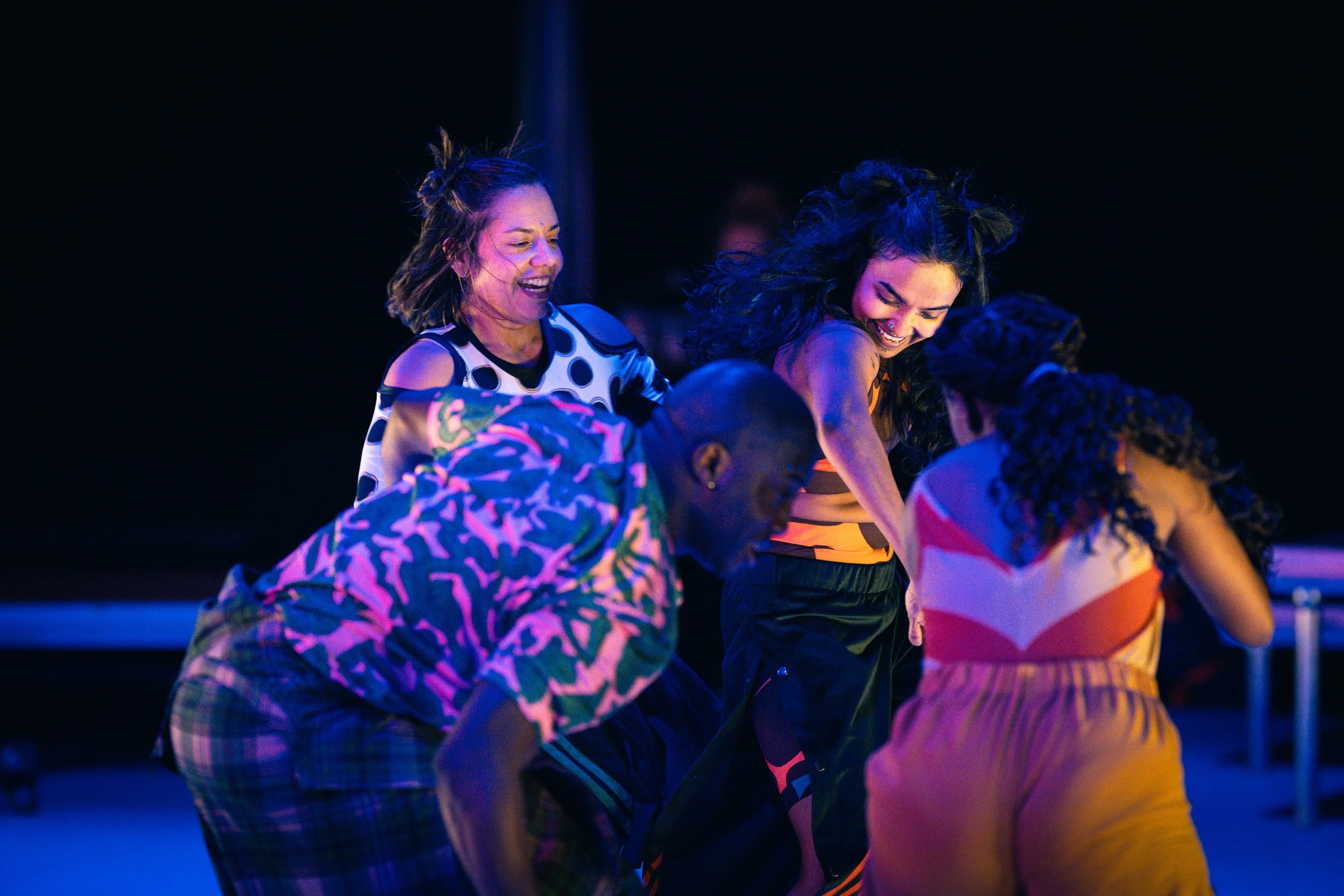
Agarrra is a landscape to inhabit, rather than to watch from afar. It unfolds through bodies layered by sediments of movement, tradition, and technique. On stage is four dancers, and each dancer carries a story marked by what they have inherited, learned, and forgotten. What threads of home do we carry across borders? What is held against, and what must be left behind?
At the center of the work lies one fundamental action: to hold. Through this simple act, personal and collective movement languages find shared pulses and common threads. Each form, holding its own social and political resonance, echoes stories of migration, adaptation, and belonging. Agarrra traces the ever-changing nature of cultural traditions, continually preserved, adapted, and reinvented through diasporic narratives.
The stage is transformed into a circular ground, a shared space for cohabitation where performers and audience exist together. One body made of many, and many bodies living within each single one.
"A language carries the traces of every voice that has spoken it; each accent is a reminder of history, exile, and belonging.” — Salman Rushdie, Imaginary Homelands (1991)
-
direction: Bianca Hisse and Laura Cemin
performers and co-creators: Ornilia Percia Ubisse, Valentina Martinez Mariscal, Jorge Ciprianno, Aiswarya Prathap
music and sound direction: Larie
light design and operation: Lui L’Abbate
costumes: Aleksandar Protic
Aqui eu posso sonhar
2025
Light design and operation
-
A dance-theater creation in which the body—so often silenced—finds a space for reinvention within the realm of dreams. Balancing delicacy with political urgency, Jorge Ciprianno draws upon intimate memories to give shape to marginalized queer childhoods, transforming pain into strength, presence, and a future. The work further invites reflection on how femininity and childhood challenge established norms, addressing themes of resistance and the pursuit of freedom within a context still defined by homophobia and intolerance.
-
Creation and interpretation: Jorge Ciprianno
Production and dramaturgy: Pedro Barbosa
Direction of photography and video: Joni Ricos
Scenography and costumes: Manu Curtiss
Light design and operation: Lui L’Abbate
Sound design and operation: DIDI
Guest artist: Faroxê
Production: Mais Cultura
Arrebentação - Zona de derrama
2025
Light design and operation + scenography
-
tumultuous touches polyphonic feelings /
arrebentação is arriving with extravagant tears, furious laughs and genuine failures .
The term "Arrebentação" refers to the area of the sea where waves crash. It is a space where one can observe the wind interacting with the water's surface, negotiating the forces at play just before the moment of descent and break. Arrebentação is the zone where one either waits in anticipation or learns how to pierce it.
There is a distinct sound associated with this experience; the crashing waves against the rocks resonate as you feel the power of the water reaching the shore.
It is magnetic. It is constant. It embodies the trembling condition of the earth.
In this space, they connect and embrace the dynamics of falling. They find harmony and discord in their interactions. Though they lack a shared language, they intuitively understand the presence of something greater. They meet at the intersection of their voices, listening intently, trusting in the magic between them. They express themselves through screams and tears, or perhaps through exuberant laughter.
They strive to forge a conspiracy without a predetermined narrative, inspired by the ideas of Valentina Desideri and Stefano Harney.
(It carries its secrets, as it should.
It is laid bare, as it should.
It is vulnerable but not fragile.)
"Arrebentação" may evoke the potential for what is destined to shift and fall. It serves as a vignette for the end of this world.
In « arrebentação » 5 dancers create a choreography that is rooted in kuir disorientations and trembling imaginaries.
-
Concept, Choreography & Performance: Catol Teixeira
Created with & performed by: Auguste de Boursetty, Collin Cabanis, Acauā Shereya, Laura Raio
Sound creation: Chaos Clay
Light creation: Lui L’Abbate
Rigging: Rive Vayrou
Scenography by: Catol Teixeira, Rive Vayrou, Lui L’Abbate
Costume: Yumi Ikeda Ferretti
Styling: Yann Slattery
External eye: Jonas Van
Production assistant: Dylan Huido
Administration & Production: Rabea Grand
Tour management: Jerome Pique
Co-Production: Création dans le cadre du programme (AC)COMPAGNONS du Pavillon ADC, soutenu par la Fondation Leenaards, Théâtre Vidy-Lausanne, EFFEA -Santarcangelo Festival, Points Communs - Nouvelle Scène Nationale - Cergy-Pontoise. This project is part of RESO – Dance Network Switzerland Coproduction Found.
Residency support: Point Éphémère (DRAC France), Festival actoral, CCN Ballet national de Marseille.
With support from: Pro Helvetia, Loterie Romande, Fondation Hans Wilsdorf, Ernst Göhner Stiftung
Thanks to: Maria Cristina Teixeira, Lea Genoud, Madeleine Amsler, Barbara Giongo, Chloe Demetriades, Simone Frey, Marcela Santander, Alessandra Domingues
Photo Credits: Gregory Bataradon, Mirian theus
Se não for tu
2025
Light design and operation
-
“Se Não For Tu” (“If Not You”) is a choreo-cinematic work that straddles the line between theater and cinema. The plot follows Sueli, a woman marked by the tragic loss of her parents in a car accident—an event that has left her with an obsession: to discover what happened during the 30 seconds leading up to the fatal incident. In her search for answers, Sueli falls asleep and plunges into surreal universes, where her ethical and psychological dilemmas are challenged at every turn.
It was one of the winning projects of the 3rd edition of Projeto CASA—an initiative by O Espaço do Tempo, A Oficina/Centro Cultural Vila Flor, and Cineteatro Louletano—which seeks to encourage experimentation and the emergence of new performance languages, while supporting the renewal of the national artistic landscape.
-
artistic direction and performance: Era Rolim
movement direction: Izabel Nejur
music direction: Resmorah
light design and operation: Lui L’Abbate
production: Mandí Kaibô
costumes: Alex Simões
press: João Parente
co-production: O Espaço do Tempo, A Oficina/Centro Cultural Vila Flor e Cineteatro Louletano, no âmbito do Projeto CASA
AEROMANCIA
2024
Light design and operation + scenography
-
AEROMANCIA creates fictions of a community connected through the collective rhythms of breathing and the toxicity. It proposes to “read” the air as if interpreting an oracle and to let itself be moved by the living air that performs with us. The piece is an immersive invitation to imagine a co-breathing that is not only physiological and mechanical, but also affective, transformative, delirious, sensual, and based on strange metabolisms.
The gesture of breathing connects inside and outside, dissolving their boundaries and questioning narratives of separability between human and more-than-human bodies. Breathing is possible thanks to vegetal life, which produces oxygen through the photosynthesis of plants.We are part of this continuous, warm, invisible gaseous connection, which can produce heat, vapor, smell, songs, emotions, distance, as well as intimacy. Breath can be passed into someone’s mouth, can warm hands in the cold, can provoke melting, bring sleep, relief, or pleasure. Does the skin breathe? Do the eyes breathe?
Breathing gives life and also tires; it infects, contaminates, transports, divides, and can intoxicate. Is intoxication transformation? Is intoxication losing the norm?The chemical movement of breathing generates metamorphosis.
What happens if we focus on the lungs and on what they “see,” feel, and imagine? What co-inspirations emerge?
We are co-breathers, and we understand breathing together as a political, environmental, social, affective, and erotic fact. -
research, direction, creation and performance: Amador Alina Folini
performance and co-creators: Emily da Silva y Bibi Dória
dramaturgy: Carolina Campos
light design and operation, scenography: Lui L'Abbate
costumes: Marine Sigaut
artistic assintance: Nicole Gomes
video: Patricia Black
graphic design: Maura Grimaldi
voice studies: Puçanga
pictures: Thomas Lenden
supported by: Bolsa de Formação Fundação Gulbenkian (PT), Fundação GDA - Criação de Espetaculos (PT), DAS Choreography / Universidad de las Artes de Amsterdam (NL), Plataforma Terra Batida / Festival Alkantara (PT)
residencies: DAS Choreography (NL), Espacio Parasita (PT), Espaço Piscina (PT), La Caldera (ES)
thanks to: Ritó Natàlio, Nina Botkay, Rui Antunes, Teresa Castro, Laila Nuñez, Lysandra Domingues
Landmarks
2024
Light design and operation
-
Landmarks delves into movement dynamics created by land demarcations, territory struggles and military operations across borders. Through an appropriation of movement and gestuality from various Army Field Manuals, the piece unfolds as a fast-paced moving landscape inspired by images of political resistance actions, collective presence in public space, tools for control and discipline of the body, and ways of subverting strict systems through movement.
In the piece, five dancers move through synchronized drills, marching steps and military cadences. These sequences are interwoven with performative games from The Theater of the Oppressed, a performance technique developed by Brazilian artist-activist Augusto Boal, which emerged during the Brazilian military dictatorship in the 70s.
In the Theater of the Oppressed, conflicts are performed as a form of political resistance and social change. Employing tools such as reenactment of real-life events, compositions with archival images and embodiment of histories of oppression, these techniques explore how movement can be a fundamental tool to resist enforced forms of physical circulation and dominance over contested or disputed territories.
Landmarks looks into today’s warfare infrastructures as rigid choreographic systems that enforce and dictate bodies. Looking at border landscapes as a political stage for the performance of control, the project explores how collective bodies can move against inflexible and oppressive systems, imagining new possible choreographies of freedom.
-
Co-produced by: Festspillene i Nord-Norge, 2024
Direction, Choreography and Sculptures: Bianca Hisse
Research and Drawings: Sarah Key
Textile and Graffiti: Terje Grimen
Sound Composition: Tom Monteiro
Choreography assistance: Georgiana Dobre
Co-creating performers: Sarjo Sankareh, Ian Yves Ancheta, Putli Hellesen, Przemek Kaminski, Georgiana Dobre
Costumes: Marine Sigaut
Light design: Lui L'Abbate
Producer: Martha Møkkelgjerd
Mentor: Eirún Sigurðardóttir
Language research: Carlos Ribeiro
Hélio
2022
Light design and operation
-
Renan Martins' newest creation - Hélio - is an ode to the life of Helio Martins de Souza, Brazilian ballroom dancer and maternal grandfather of the choreographer.
Working with the themes of authenticity, originality and appropriation, Renan Martins sets up the challenge to work with the 50 year old music piece Drumming, by American composer Steve Reich. As if in an inner expedition, he moves through a personal archive of folk, social and popular dances as he dialogues with his own experience as a dancer in Europe for the past 15 years.
-
choreography and performance: Renan Martins
choreography assistant: Helena Araújo
damaturgy: Ana Rocha
costume design: Nina Botkay
costumes: Eliana da Rosa Cabral
light design and operation: Lui L’Abbate
music: ‘Drumming’ from Steve Reich, played by Colin Currie Group, Synergy Group Vocals & Colin Currie
production: Sekoia Artes Performativas
management and distribution: Laya Montoya - TINAAgency
supported by: Bolsa de Criação - O Espaço do Tempo / BPI – Fundação “la Caixa”, Choreographisches Centrum Heidelberg, Armazém 22/Kale Companhia de Dança. Residenzen: Inter-Actions Studio, O Espaço do Tempo, Choreographisches Centrum Heidelberg, CAMPUS Paulo Cunha e Silva, Armazém 22
APOCALYPSO
2022
Light design and operation
-
In this space where we meet, the walls soften. They grow damp, beginning to exude a fluid rich in pheromones that signals calm and pleasure to us. We, too, begin to perspire lightly, our orifices relaxing and becoming lubricated. I place my index finger in my mouth, and with the saliva I gather, I trace a crossroads upon the floor. The wet trail begins to glow, while the space within these paths grows dark. We stand at the heart of the crossroads, and the four directions surrounding us spiral, glide, explode, and replicate.
We follow every path simultaneously.
The word "apocalypse" derives from the Greek APO—to remove—and KALUMA—a veil—literally meaning "to unveil." To un-veil. To reveal. We conceive of APOCALYPSO as a way to strip away the veils covering the invisible structures of the colonial world—a means of dismantling it. This destruction unfolds at a sensory crossroads that activates the body as a cartographic site of passage, where performativity, spirituality, fiction, and sorcery intersect, blurring their own boundaries.
APOCALYPSO is a duo conceptualized and directed by Luara Raio, performed and co-created with the Brazilian dancer and choreographer Shereya. The scenography is the work of performance artist and set designer Anat Bosak, with lighting design by performer and lighting designer Lui L’Abbate. The creative process began in December 2021 at the ICI-CCN (International Choreographic Center of Montpellier) as part of the exerce master’s program.
-
Conception and dramaturgy Luara Raio
Choreography and performance Luara Raio and Shereya
Scenography and costumes Luara Raio and Anat Bosak
Light design Lui L’Abbate
Artistic residencies Honolulu Residency (Nantes, França), Criatório – Circolando (Porto, Portugal), ICI—CCN (Montpellier, Frana), Forum Dança (Lisboa, Portugal)
Executive production Ivvi RomãoSupport ICI—CCN, Circolando, Centro Cultural de Belém, Rua das Gaivotas 6, O Espaço do Tempo
Project finances by República Portuguesa – Cultura | DGARTES – Direção-Geral das Artes.
Beton
2021
Light design and operation
-
The overvaluation of urban spaces finds shelter in the notion of evolution, which knows no con-straints when the goal is the accidental repurpose of its population or its deliberate control.
-
choreography and performance: Sara Silva, Thamiris Carvalho and Vinicius Ferreira
light design and operation: Lui L’Abbate
VIADUTO
2021
Light design and performative operation
-
VIADUTO is inspired by the concept of party.
First, by its search and observation.
Then, by its experience and contemplation.
2013 is marked by significant events in Rio de Janeiro, Brazil. One of them is the demolition of one of its fundamental constructions, Elevado da Perimetral, a viaduct connecting major city parts with the periphery. Renan Martins investigates that moment in time, together with musician Frankão, to connect with the party as a tool for political resistance and as practice for collectivity.
-
Artistic direction and choreography: Renan Martins
Live music: Frankão
Dramaturgy: Ana Rocha
Created and danced by: João Cardoso, Mar Grifoll, Maria Ferreira Silva, Nina Botkay, Thamiris Carvalho
Lighting design: Lui L’Abbate
Produced by: Sekoia ‑ Artes Performativas
Supported and coproduced by: Teatro Municipal do Porto/ DDD ‑ Festival Dias de Dança, Sekoia, Espaço do Tempo, Vitlycke Centre for Performing Arts, Mão Esquerda
Special thanks to: Víctor Pérez Armero
In Ritual
2021
Light design and operation
-
Ritual creates the link with the world, the environment, the community, in perpetual movement. It shows us how to connect and situate ourselves in the world, within and without ourselves. It can contribute to the rebirth of a person or a community, facilitating change, releasing tension and affirming wisdom. In many traditions, dance is linked to ritual.
In Ritual explores this aspect of dance and attempts to create our contemporary ritual, drawing performers and audience into a whirlwind of connection, metamorphosis and celebration.
-
Choreography and dance: Yuko Kominami & Joana Von Mayer Trindade
Installation: Ana Maria Pintora
Music: Tomás Tello
Light: Lui L’Abbate
UNA
2021
Light design and operation
-
UNA is a performative research project concerning HIV, rooted in biographical, biomedical, and socio-political inquiries. Through a dramaturgy built upon metaphors and bodily states, the project engages with the concept of kintsugi—a Japanese philosophy that finds value in flaws and fissures—by exploring the experience of a body that dances through life, uncovering new meanings amidst adversity. It examines the processes of bodily and identity transformation driven by living with the virus, reflecting on how these shifts might metaphorically illuminate paths for the present moment. UNA speaks of shedding one’s skin and embracing a new way of being. It is a raw performance that addresses social issues such as discrimination, oppression, and the paradoxes and resilience of bodies as they engage with these realities.
-
Creation and interpretation: Teresa Fabião
Video: Luís Rosa Lopes
Soundtrack: Cláudio Tavares
Light design: Lui L’Abbate
Costumes: Patrícia Costa
Production: Clara Charmel & Patrícia Dis
Design: Pedro Faria Cunha
Digital comunication: Margarida Mata
Dramaturgy support: Ronaldo Serruya & Luis Mestre
Acting support: Luciano Amarelo
Recordings and trailer: Carlos Dias Produções
Collaboration [voz-off]: Celina, Isabel, Felipe Machado, Franco Fonseca, Luca Modesti, Paolo Gorgoni, Sónia Cardoso, Xan Marçal, Julie Dowling
Funding: Fundação Gulbenkian, Fundação GDA, Estúdios Victor Cordon, CAMPUS Paulo Cunha e Silva / TMP / Rivoli
Alive… & then Some
2019
Light design and operation
-
Gone, yet still composing …
Shifting fictions collectively.
Alive … & then Some is a workshop + performance series conceived by Emma Waltraud Howes & Just in F Kennedy to research and analyze the experience and translatability of trance forms. The attempt to reach and analyze different states of trance is at the core of the workshop portion of this series. The performance aspect focuses on how to translate these seemingly interior, and personal processes of profound or transcendental experience, into collective material suitable for live performance. Applying a methodology of deep observation developed in Wormhole Through Your Brain, Alive … & then Some plunges without hierarchy into various trance states. Exercises include but are not limited to: Osho dynamic mediation, Ba gua, sacred helixing, internal wave energy, group hypnosis, holy ghost method acting, soft headbanging, wavebouncing, and metal baroque. Through remembrance, automatic response, screenings, readings and archiving, the workshop discusses the analytic aspects of trance forms to address the challenges of documenting and interpreting profound experience. The materials generated through this practice are processed through a choreographic and theatrical “wood chipper” and spat out as a live performance in the form of a lucid (sci-fi) opera.
-
arranged by: Ana Rocha
by, with, for: Justin Francis Kennedy, Caspar Rode, Andreas Gurewich, Vlad Gurewich, Dylan Spencer Davidson, Emma Waltraud Howes, Florian Lenz, Lauryn Youden, Tara Chumpelik, & Helena Remeijers Molhoek
light design and operation (Ateneu Comercial do Porto): Lui L’Abbate
Rubble King
2019
Light design and operation
-
Rubble King introduces a brief span of attention—an investigative creature of the archetype. It is an entity within a sandbox, a site of limitless information, an overly productive circuit in search of archetypes upon which to feed. This universal body is viral—an unfiltered circuit, interrupted at random by self-gratification. Glimpses of actual structures of movement appear, as if they were clouds hovering and reflecting thoughts. Change, change, change—various states unfolding through shifting attention, all while evading any conclusion: a rational absurdity.
-
artistic direction: Duarte Valadares
co-creation: André Cabral and Marco da Silva Ferreira
performed by: Marco da Silva Ferreira / Duarte Valadares
visual artis: Oscar Cassamajor
music by: Olli Lautiola
costumes: Pawel Androsiuk
light design: Lui L’Abbate
co-production: Instável – Centro Coreográfico e Teatro Municipal do Porto
supported by: Cie Thor, Jazzy Dance Studios – Santos, Estúdio CAB – Centro Coreográfico de Lisboa, Centro de Criação do Imaginarius, Instável – Centro Coreográfico